In my last post, I walked you through Rockwell Automation's full controller lineup, including a brief look at where CompactLogix fits in the picture. In this post, I'm going to go much deeper on one specific platform: the CompactLogix 5380.
By the end, you'll understand:
- What the CompactLogix 5380 is and where it sits in the Logix 5000 family,
- How to read a 5069 catalog number,
- The hardware and software features built into the platform, and
- The physical components that make up a complete system
What Is the CompactLogix 5380?
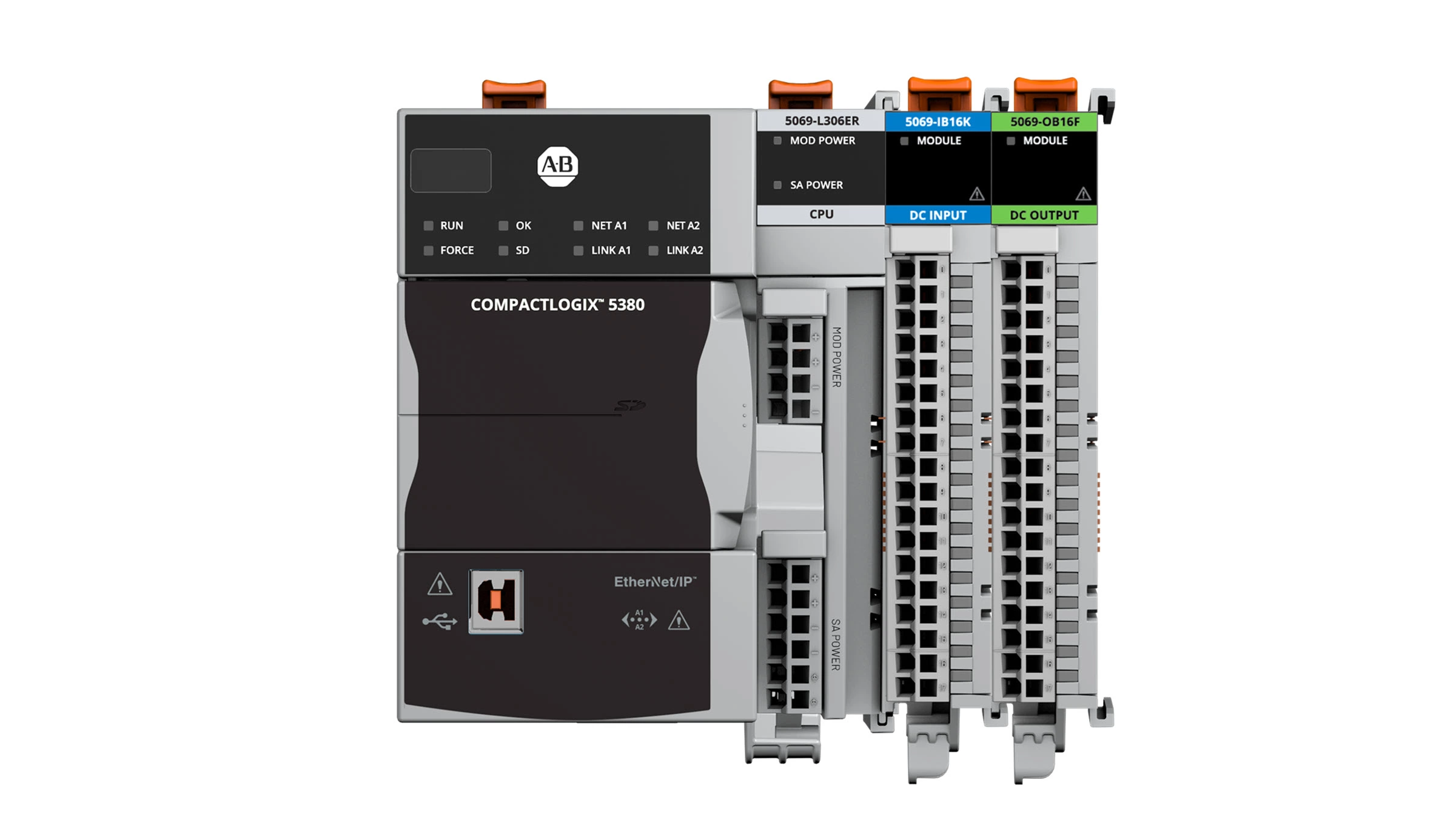
The CompactLogix 5380 is Rockwell Automation's mid-range Logix 5000 controller platform, designed for standard machine and process control applications. Its bulletin number is 5069, and it uses the 5069 Compact 5000 I/O platform for local I/O modules.
It's part of the broader Logix 5000 family, which means it's programmed with Studio 5000 Logix Designer and shares the same tag-based programming model as ControlLogix. Compared to the previous generation CompactLogix 5370 (1769 series), the 5380 delivers substantially higher performance: up to 5 to 20 times faster scan time, dual gigabit Ethernet ports instead of 100 Mb ports, double the motion axis support (up to 32 axes vs. 16), and up to 180 EtherNet/IP nodes vs. 90.
Reading a CompactLogix 5380 Catalog Number
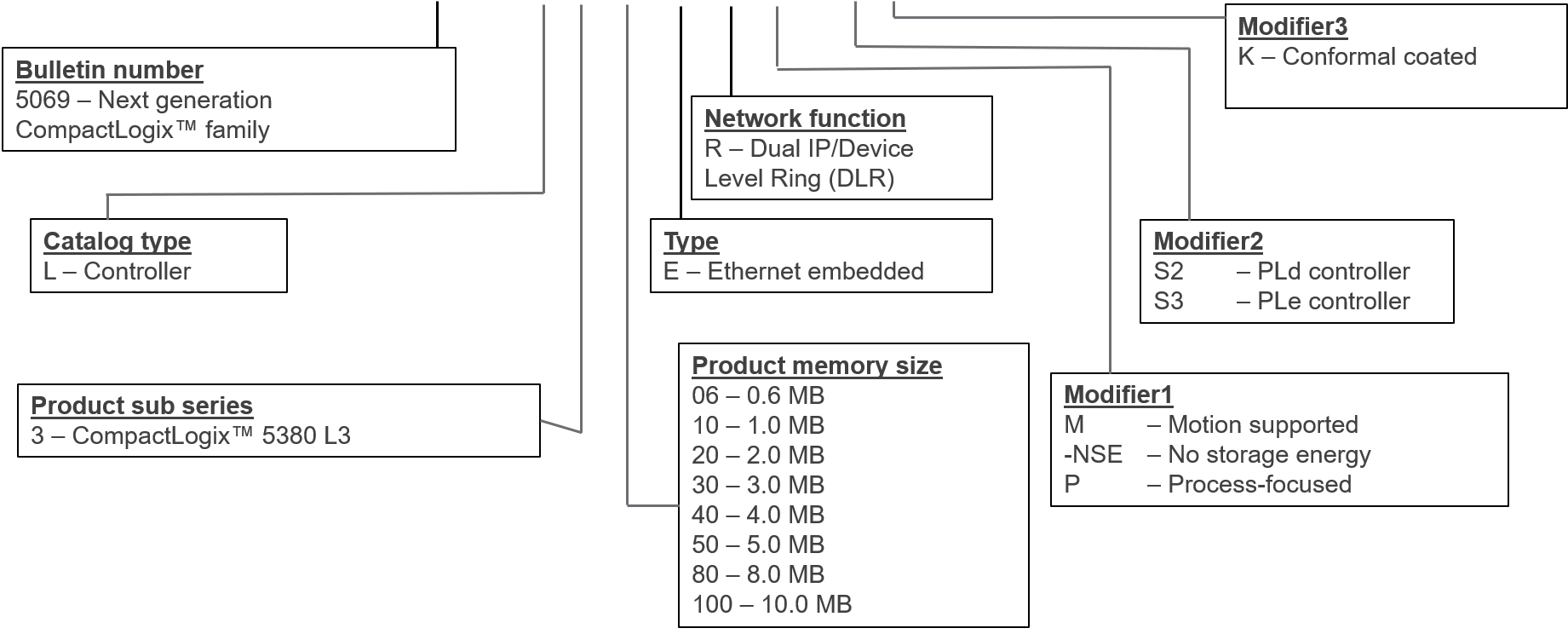
All 5069 controllers follow a structured catalog number format. Here's how to decode one, using 5069-L340ERM as an example:
- 5069 — Bulletin number, identifies the Compact 5000 / CompactLogix 5380 family
- L — Controller (Logix processor)
- 3 — Product sub-series (CompactLogix 5380 L3)
- 40 — Memory size (4.0 MB)
- E — Ethernet embedded
- R — Network function: Dual IP / Device Level Ring (DLR)
- M — Motion supported
Optional suffixes include P for process-focused controllers, S2/S3 for safety-rated controllers (Compact GuardLogix, PLd/PLe), -NSE for no storage energy, and K for conformal coating. So a catalog number like 5069-L340ERMS2 is a 4 MB, motion-capable, safety-rated (PLd) controller.
The full range of memory sizes currently available runs from 0.6 MB (L306) up to 10 MB (L3100), with motion-capable models (M suffix) supporting between 2 and 32 axes depending on the model.
Hardware Features
The CompactLogix 5380 packs a significant set of hardware features into a compact, rackless package.
Rackless Design
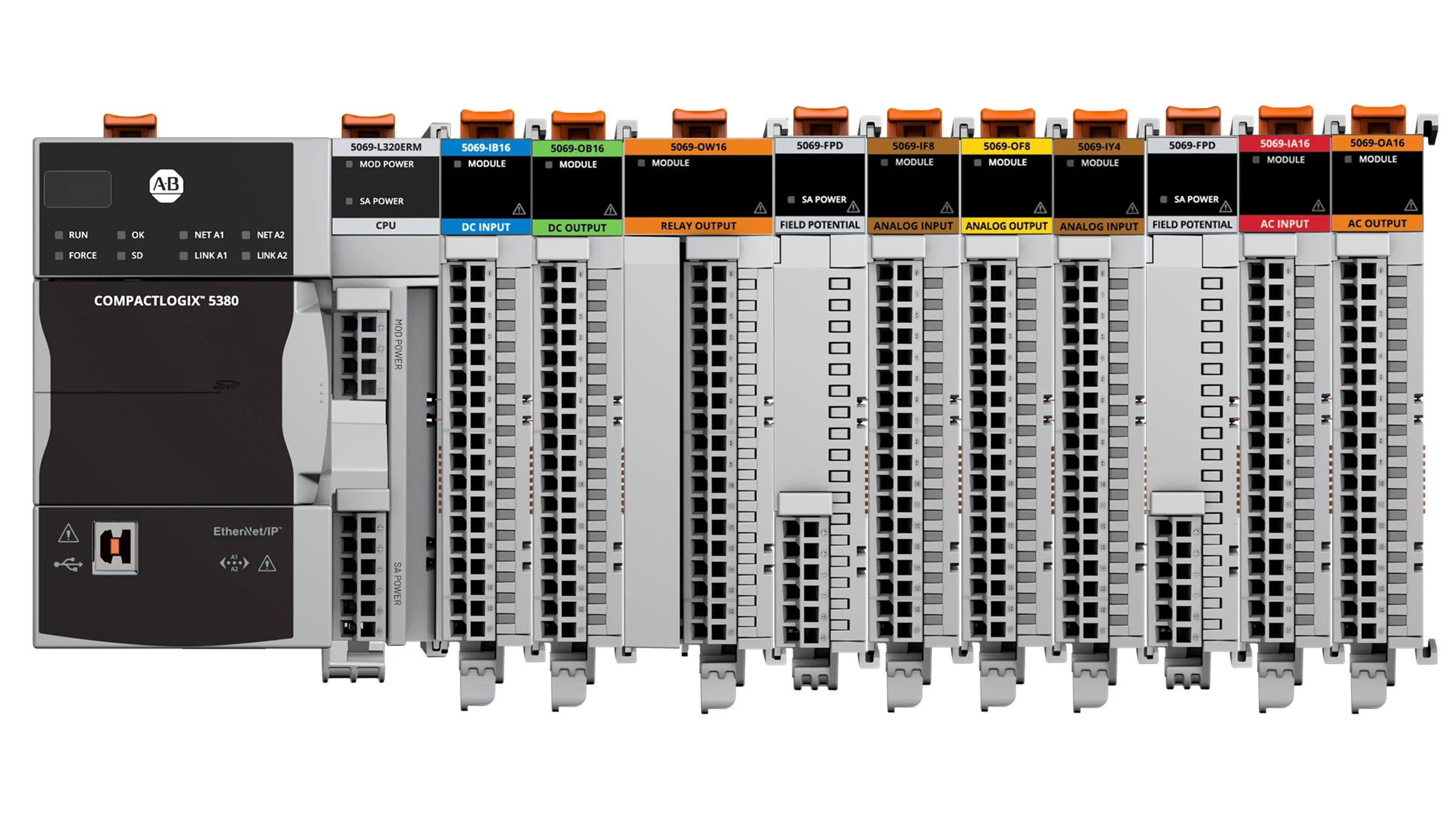
Unlike ControlLogix, the CompactLogix 5380 doesn't require a separate chassis. I/O modules attach directly to the right side of the controller and to each other, snapping together via a backplane connector. The 5380 supports up to 31 local Compact 5000 I/O modules.
This rackless design also results in a smaller footprint than previous generations. Compared to an equivalent CompactLogix 5370 system, the 5380 reduces panel space by roughly 30%, and compared to a CompactLogix 1768 system, by around 70%, partly because built-in features eliminate the need for separate Ethernet and power supply modules.
Dual Gigabit EtherNet/IP Ports
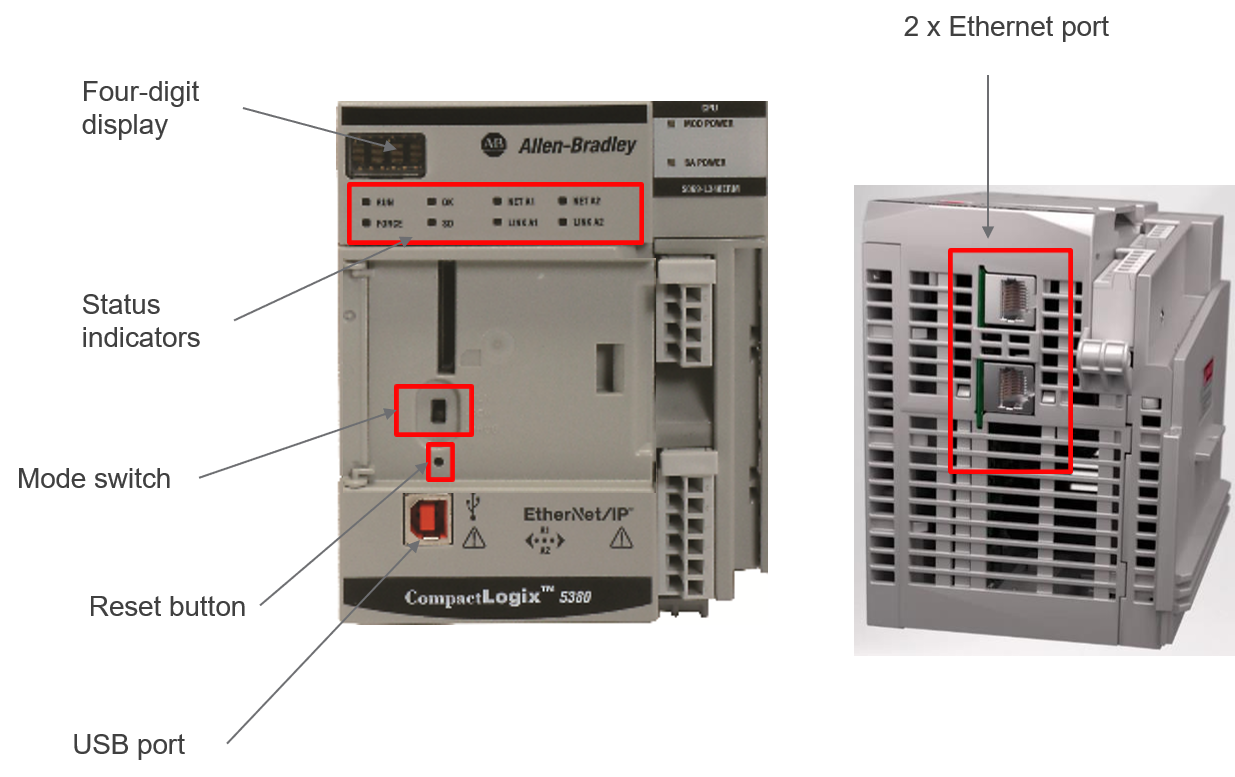
Every 5380 controller includes two built-in 1 Gb EtherNet/IP ports. These ports can be configured in two ways:
Dual-IP mode assigns a separate IP address to each port, allowing the controller to connect simultaneously to two different network segments, for example, a machine-level network and a plant-level network. This provides logical and physical separation between the control network and the enterprise network without needing a separate network address translation (NAT) module.
Device Level Ring (DLR) mode uses both ports to form a ring topology, which provides network resiliency. If the ring is broken at any point, communication is automatically rerouted through the other path.
USB Port
A USB port on the front of the controller provides a local connection for programming, troubleshooting, and firmware updates without needing Ethernet connectivity.
SD Card Slot
An SD card slot allows projects to be stored on and loaded from the card. This is useful for backing up the project directly on the controller, loading a project onto a replacement controller without a laptop, or pre-staging multiple identical systems.
Four-Character Status Display
The front panel of the controller includes a four-character scrolling display that shows the current status of communications, module health, and I/O fault activity without requiring Studio 5000 Logix Designer to be open. This is a significant improvement over the simpler LED indicators on older controllers.
Mode Switch
A three-position mode switch (RUN / PROG / REM) provides a physical layer of security, preventing unauthorized mode changes from software when the switch is in RUN or PROG position.
Power Architecture: MOD Power and SA Power
CompactLogix 5380 systems use two separate power buses, provided via removable terminal blocks (RTBs) on the controller:
MOD power (module power) supplies operating power to the controller and I/O module electronics via the backplane. It's fed by an external 24VDC power supply connected to the MOD power terminals on the left side of the controller.
SA power (System Actuator power) supplies field-side power to output modules for driving actuators like solenoids and lights. It's provided by a separate 24VDC source. A 5069-FPD Field Potential Distributor module can be inserted at any point in the I/O assembly to start a new SA power segment, which allows field power to be cut to a portion of the outputs without powering down the whole system.
Keeping MOD and SA power separate is an important design principle: it lets you isolate field power from the controller electronics, which is useful for safe state requirements and maintenance.
Enhanced Security
The 5380 includes digitally signed and encrypted firmware to help protect against malicious modification, controller-based change detection with logging, and role-based access control for routines and Add-On Instructions. Combined with the physical mode switch, these features give you multiple layers of security for applications where that matters.
Runtime Memory Architecture
One notable improvement over the 5370 is how runtime memory is handled.
On the 5370, Rockwell recommended leaving at least 20% of application memory reserved for runtime consumers like MSG instructions, HMI trends, and online edits.
On the 5380, runtime memory is separated from application memory, which means you can use 100% of the application memory for your program. This effectively gives the 5380 about 20% more usable memory than a same-sized 5370 controller.
Software Features
The CompactLogix 5380 is programmed using Studio 5000 Logix Designer version 28 or later. Version 29 or later is required to use Dual-IP mode.
All standard Logix 5000 programming languages are supported: Ladder Diagram, Structured Text, Function Block Diagram, and Sequential Function Chart. One of the notable performance improvements in the 5380 is that Structured Text now executes at roughly the same speed as Ladder Diagram, which was not the case on the 5370 where Structured Text was significantly slower.
Other software capabilities include over 250 predefined instructions in the instruction palette, Add-On Instructions for creating reusable custom instruction sets, integrated safety and motion programming in the same environment, and native Process instructions for PlantPAx 5.0 integration on process-focused models.
Compact 5000 I/O System
The 5380 uses the 5069 Compact 5000 I/O platform for local I/O modules. These modules are 40% smaller than the previous-generation Compact I/O modules and offer improved performance, including a high-speed backplane with a packet transfer rate of 4.4 microseconds for a 511-byte packet.
Module types available include AC/DC digital input and output, high-speed counter, analog, universal analog input, EtherNet/IP adapter, relay output, serial, and field power distribution modules.
Each module uses a removable terminal block, which makes wiring and module replacement straightforward: you can wire the terminal block off the module and plug it back in.
Available Controller Models
The table below shows the standard CompactLogix 5380 catalog numbers with their key specifications:
| Catalog Number | Memory | Max I/O Modules | EtherNet/IP Nodes | Motion Axes |
|---|---|---|---|---|
| 5069-L306ER | 0.6 MB | 8 | 16 | 0 |
| 5069-L310ER | 1 MB | 8 | 24 | 0 |
| 5069-L320ER | 2 MB | 16 | 40 | 0 |
| 5069-L330ER | 3 MB | 31 | 60 | 0 |
| 5069-L340ER | 4 MB | 31 | 90 | 0 |
| 5069-L306ERM | 0.6 MB | 8 | 16 | 2 |
| 5069-L310ERM | 1 MB | 8 | 24 | 4 |
| 5069-L320ERM | 2 MB | 16 | 40 | 8 |
| 5069-L330ERM | 3 MB | 31 | 60 | 16 |
| 5069-L340ERM | 4 MB | 31 | 90 | 20 |
| 5069-L350ERM | 5 MB | 31 | 120 | 24 |
| 5069-L380ERM | 8 MB | 31 | 150 | 28 |
| 5069-L3100ERM | 10 MB | 31 | 180 | 32 |
Process-focused variants (5069-L320ERP, 5069-L340ERP) are also available with native Process instructions and conformal coating options for harsh environments.
General Specifications
- Operating temperature: 0 to 60°C (32 to 140°F)
- Storage temperature: -25 to +85°C (-40 to +185°F)
- Relative humidity: 5 to 95% noncondensing
- Maximum altitude: 2000 meters
- Vibration: 5 g, 10 to 500 Hz
- Operating shock: 30 g DIN rail mounted
- Dimensions: 143.97 mm H x 98.10 mm W x 136.81 mm D
Wrap Up
The CompactLogix 5380 is a capable, compact controller that punches well above its size. The rackless design keeps the panel footprint small, the dual gigabit Ethernet ports give you flexible network architecture options, and the separation of runtime from application memory means you get full use of every byte you pay for.
If you're ready to start working with one, check out my post on how to create a project in Studio 5000 Logix Designer as your next step.
Learn PLC Programming in your browser
Learn PLC programming by building projects in your browser - no hardware or software required.
Then €29.97/month · Cancel any time